• Home
  • About
  • My Blog
  • Food & Drink
  • Travel Info
  • Dictionary
  • Postcards
    • Pharmacy of the Incurabili - Farmacia degli Incurabili
    • Museo Archeologico Nazionale
    • Museo di Capodimonte
    • Gallerie d'Italia - Napoli
    • Museum of Paleontology
    • Royal Palace and Piazza Plebiscito
    • Teatro San Carlo
    • Castel Nuovo - Maschio Angioino
    • Villa Floridiana
    • Castel dell'Ovo
    • Madre - Contemporary art Museum
    • Cemetery of the Fontanelle
    • San Martino and Sant' Elmo Castle
    • Aquarium
    • Villa Pignatelli
    • Gerolamini Church and Art Gallery
    •  The Royal Botanical Garden
    • Gesu' Nuovo
    • Santa Chiara Church and Cloister
    • San Domenico Maggiore
    • Sansevero Chapel
    • Sant'Angelo a Nilo
    • Chapel of Monte di Pietá
    • San Pietro a Maiella
    • Santa Maria delle Anime del Purgatorio
    • San Paolo Maggiore
    • San Lorenzo Maggiore
    • San Gregorio Armeno
    • Pio Monte della Misericordia
    • Duomo - Cathedral
    • Santi Apostoli
    • San Giovanni a Carbonara
    • Sant'Anna dei Lombardi (Monteoliveto)
    • Santa Maria La Nova
    • San Francesco and Paola
    • San Ferdinando
    • Santa Brigida
    • POMPEII
    • HERCULANEUM
    • SORRENTO COAST
    • SORRENTO
    • AMALFI COAST
    • POSITANO
    • AMALFI
    • RAVELLO
    • CAPRI
    • ISCHIA
    • PROCIDA
  • Contact
Menu

Girl from Naples

info & stories about Naples, Italy.
  • Home
  • About
  • My Blog
  • Food & Drink
  • Travel Info
  • Dictionary
  • Postcards
  • Museums
    • Pharmacy of the Incurabili - Farmacia degli Incurabili
    • Museo Archeologico Nazionale
    • Museo di Capodimonte
    • Gallerie d'Italia - Napoli
    • Museum of Paleontology
    • Royal Palace and Piazza Plebiscito
    • Teatro San Carlo
    • Castel Nuovo - Maschio Angioino
    • Villa Floridiana
    • Castel dell'Ovo
    • Madre - Contemporary art Museum
    • Cemetery of the Fontanelle
    • San Martino and Sant' Elmo Castle
    • Aquarium
    • Villa Pignatelli
    • Gerolamini Church and Art Gallery
    •  The Royal Botanical Garden
  • Churches
    • Gesu' Nuovo
    • Santa Chiara Church and Cloister
    • San Domenico Maggiore
    • Sansevero Chapel
    • Sant'Angelo a Nilo
    • Chapel of Monte di Pietá
    • San Pietro a Maiella
    • Santa Maria delle Anime del Purgatorio
    • San Paolo Maggiore
    • San Lorenzo Maggiore
    • San Gregorio Armeno
    • Pio Monte della Misericordia
    • Duomo - Cathedral
    • Santi Apostoli
    • San Giovanni a Carbonara
    • Sant'Anna dei Lombardi (Monteoliveto)
    • Santa Maria La Nova
    • San Francesco and Paola
    • San Ferdinando
    • Santa Brigida
  • Trips
    • POMPEII
    • HERCULANEUM
    • SORRENTO COAST
    • SORRENTO
    • AMALFI COAST
    • POSITANO
    • AMALFI
    • RAVELLO
    • CAPRI
    • ISCHIA
    • PROCIDA
  • Contact

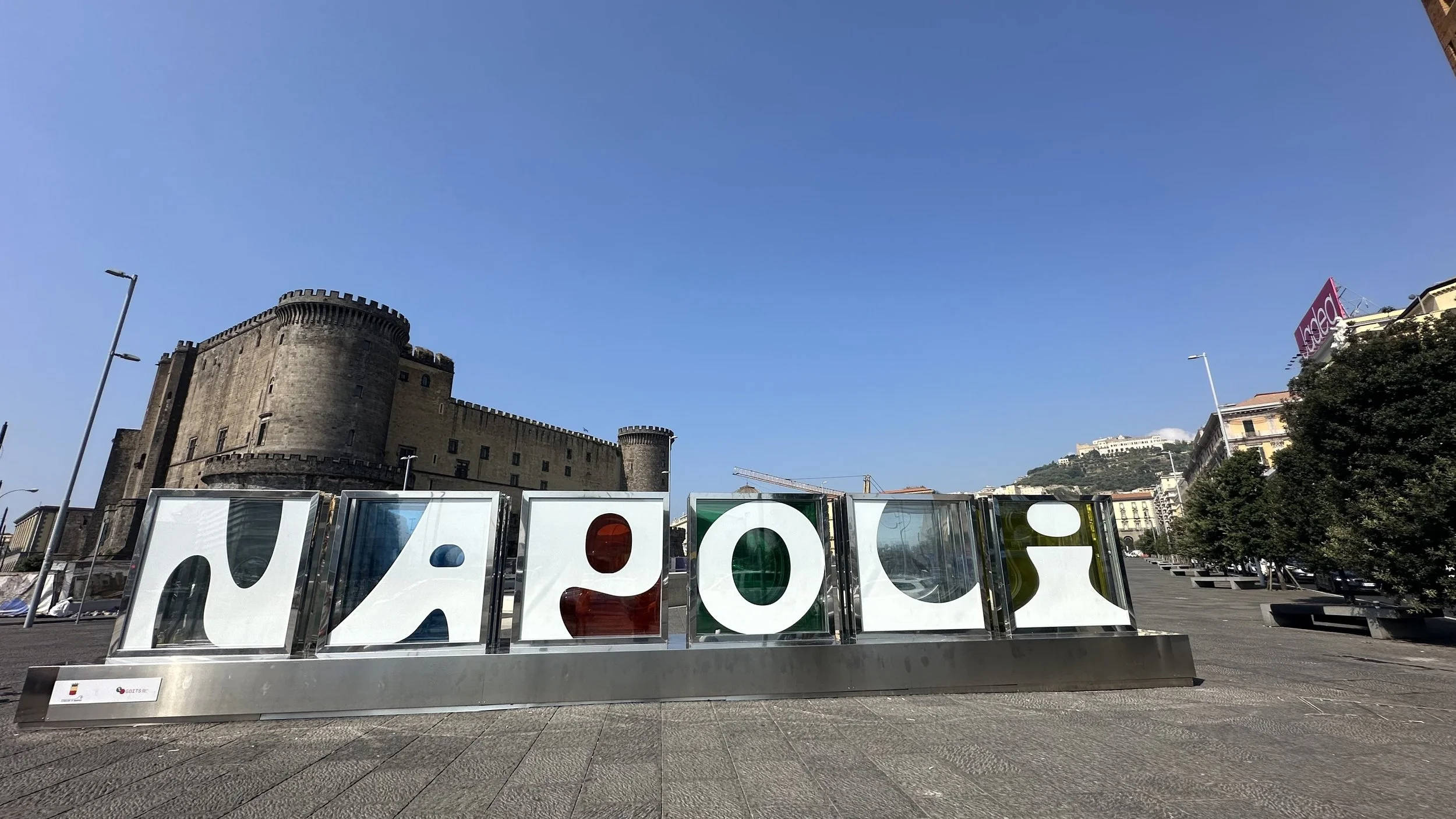
Welcome to Napoli.

A new city between Myths and History. The origins of Napoli.

May 4, 2026

On December 21st 2025, Napoli celebrated its 2500 year old birthday. I shall say thats not too bad for this old city, which has seen volcanic eruptions, earthquakes, plagues, and wars. It’s been destroyed several times over and yet still survives, and furthermore, is keeping one eye open in modernising the for future. In 2027 Naples hosts the Americas Cup and Line 1 of the Metro finally links up to the Airport.
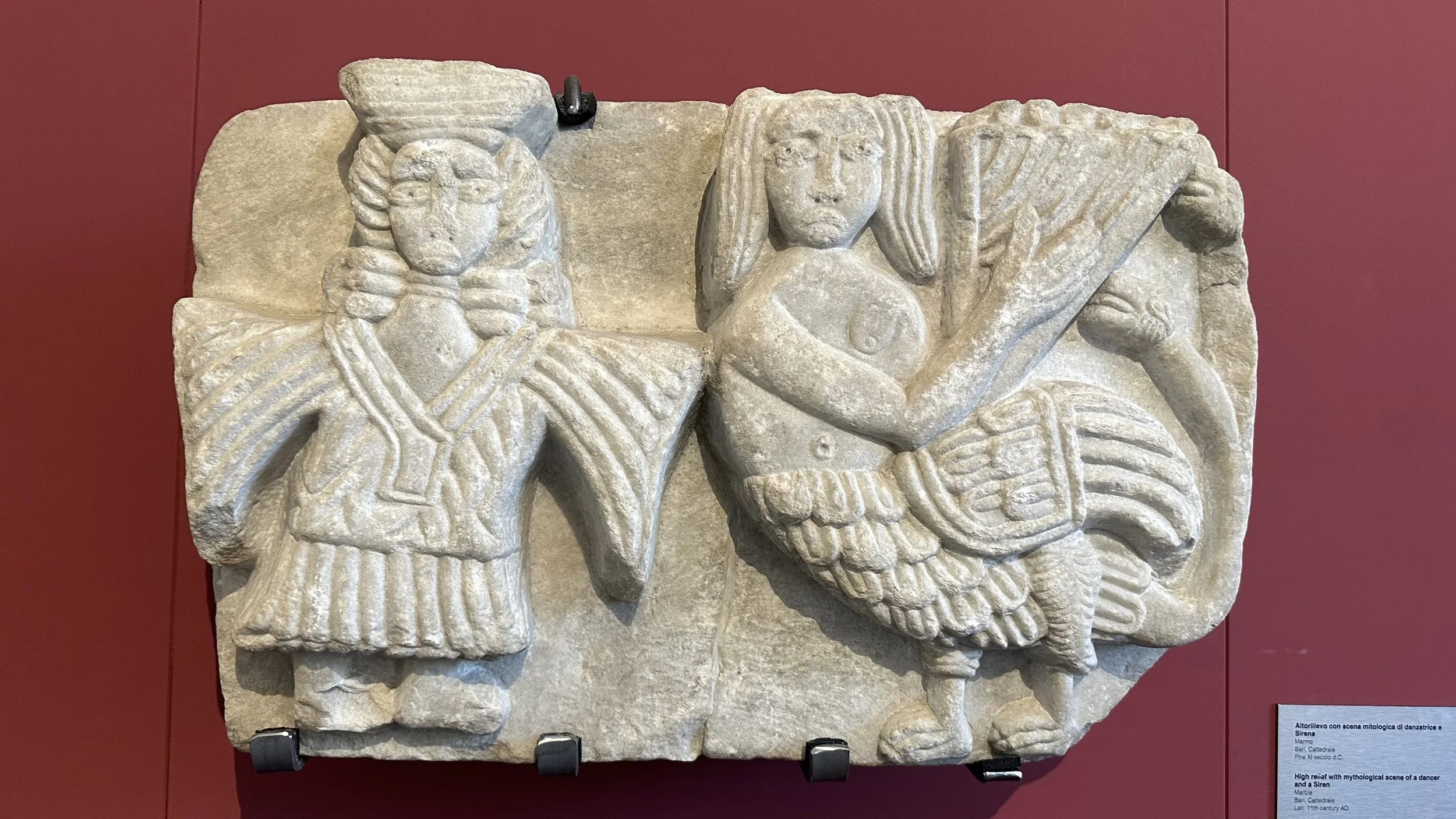
High relief with a mythological scene of a dancer and a siren, 11th century AD.
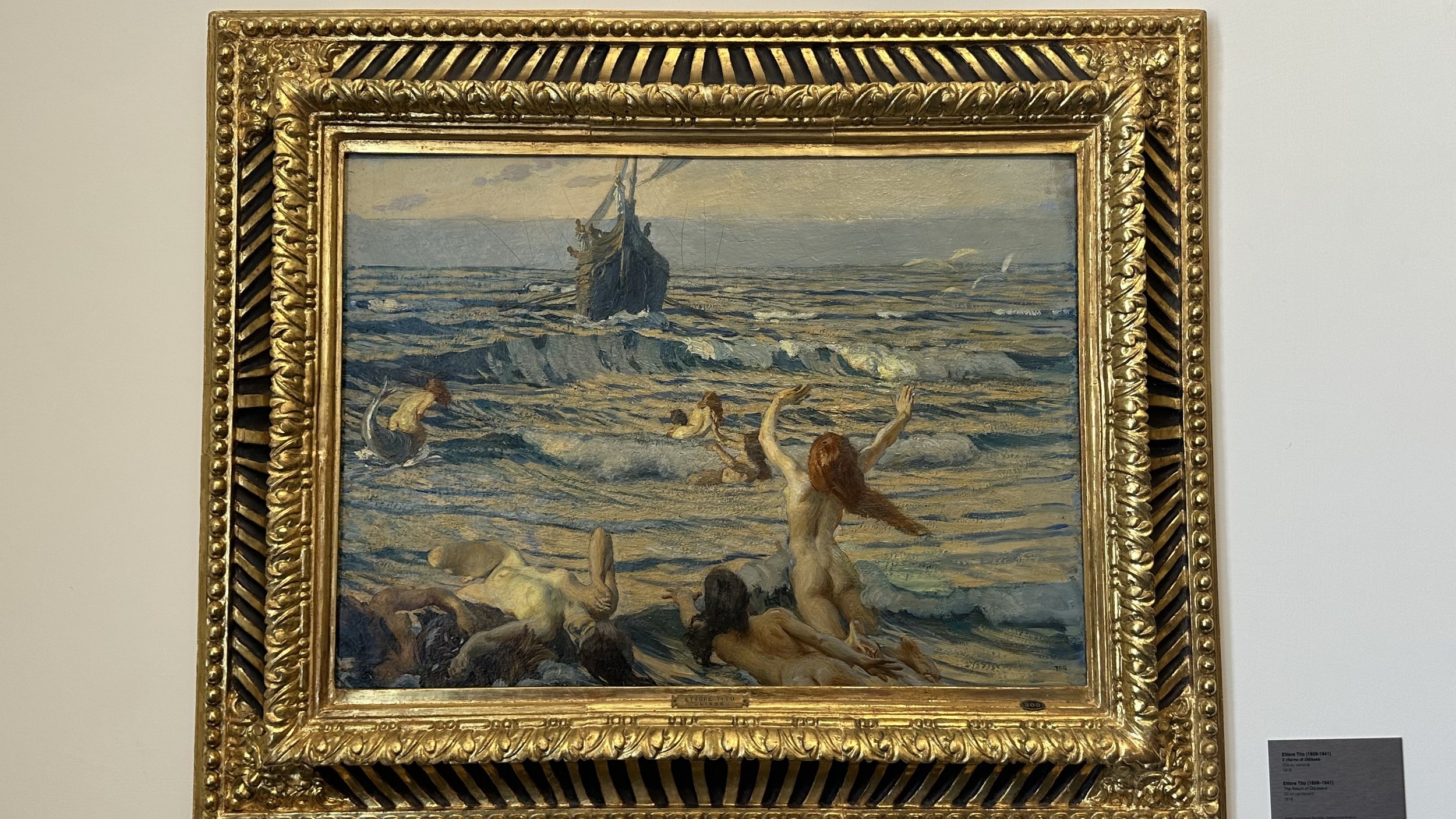
The Return of Odysseus, 1919 - Ettore Tito (1859-1941)
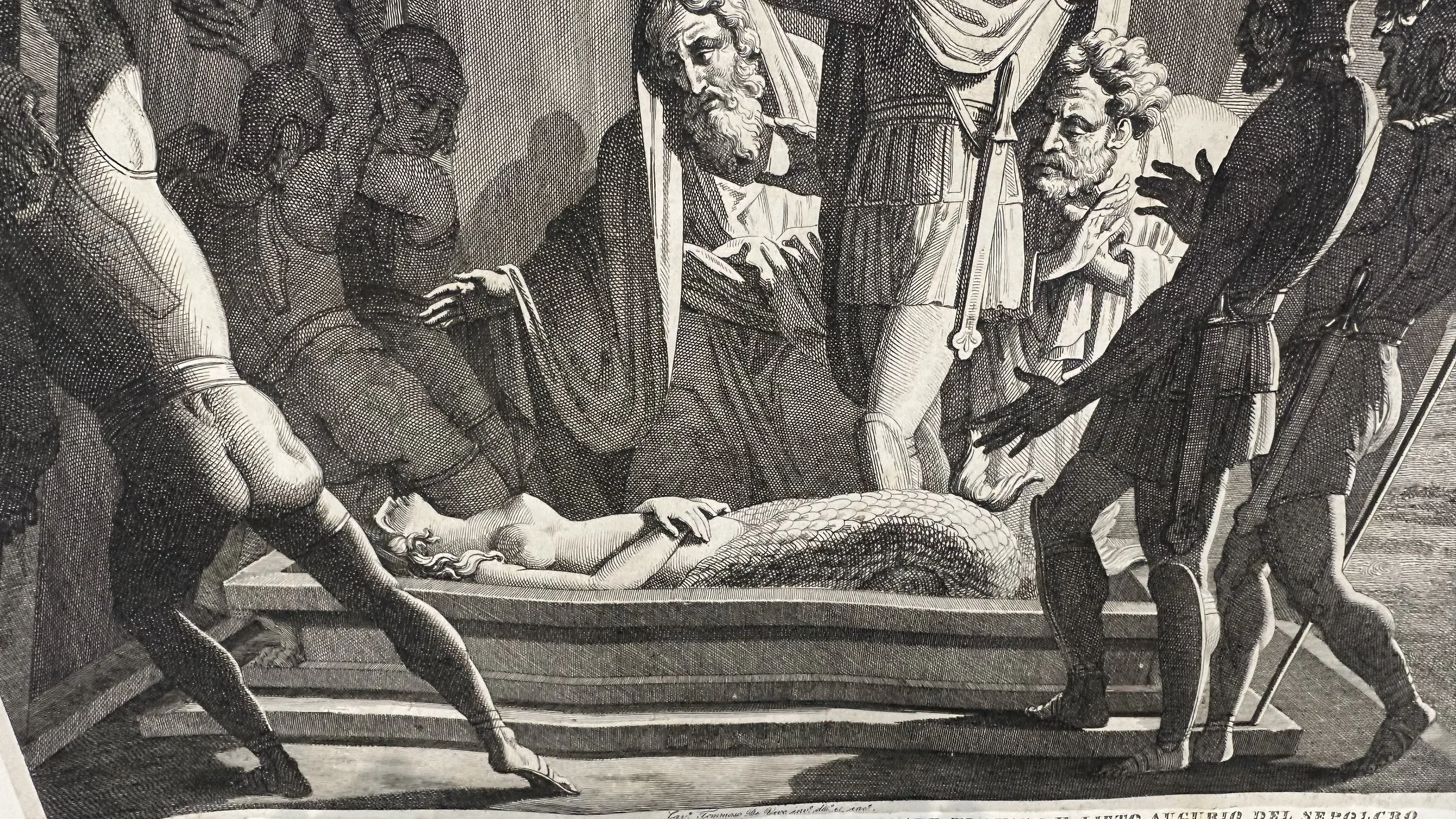
Engraving of the Greeks finding the body of the mermaid Parthenope.

The legend tells us that Napoli was founded by the most beautiful of all the mermaids, Parthenope. In the Odyssey, Ulysses passes near the island of the mermaids (possibly the island of Li Galli in front of Positano) forcing himself and his crew not to listen to the charming and hypnotic voices and songs of the mermaids.  Parthenope, whom failed in the intent to seduce Ulysses, killed herself.  The waves took her body to the islet of Megaride (where the Castel dell'Ovo is now situated) where she was buried.
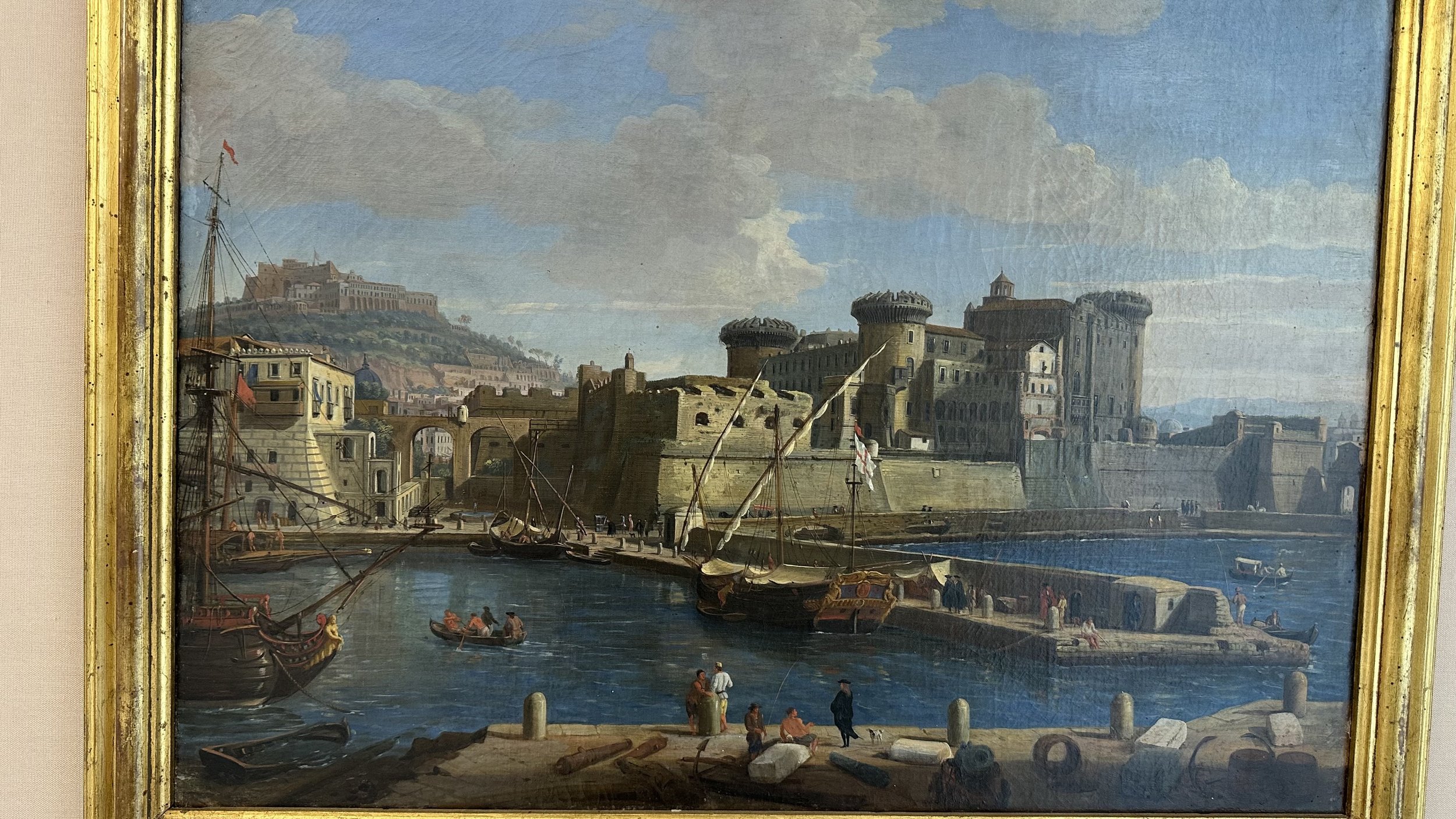
Stylised view of the seafront Castel dell’Ovo by Gaspar van Wittel (Amersfoort 1653 - Roma 1736).

It is a fact that during the centuries Napoli has charmed many kings, emperors, princesses, knights, scientists, philosophers, artists, architects, filmmakers, songwriters and tourists.  It might be for its strategic position in the Mediterranean, the lovely climate or the beauty of its nature. 

The first inhabitants were a small tribe of fishermen living in the area called Parthenope, by the sea front in the little island of Megaride around the VII century B.C. Then the ancient Greeks saw the potential of this area as an important port in the Mediterranean sea and established their own settlement in the second millennium B.C. and then expanded the city to what we now call the historic center ‘centro storico’.  

Very soon this city which the Greeks called Neapolis (new city) became the new centre of commercial life, vibrant and the most important city of the Magna Graecia.  The layout of the city we still see today was created by the Greeks: three long parallel streets, ‘decumani’, that today are Spaccanapoli, via Tribunali and via Benedetto Croce. You can still remnants of the old Greek walls in Piazza Bellini.
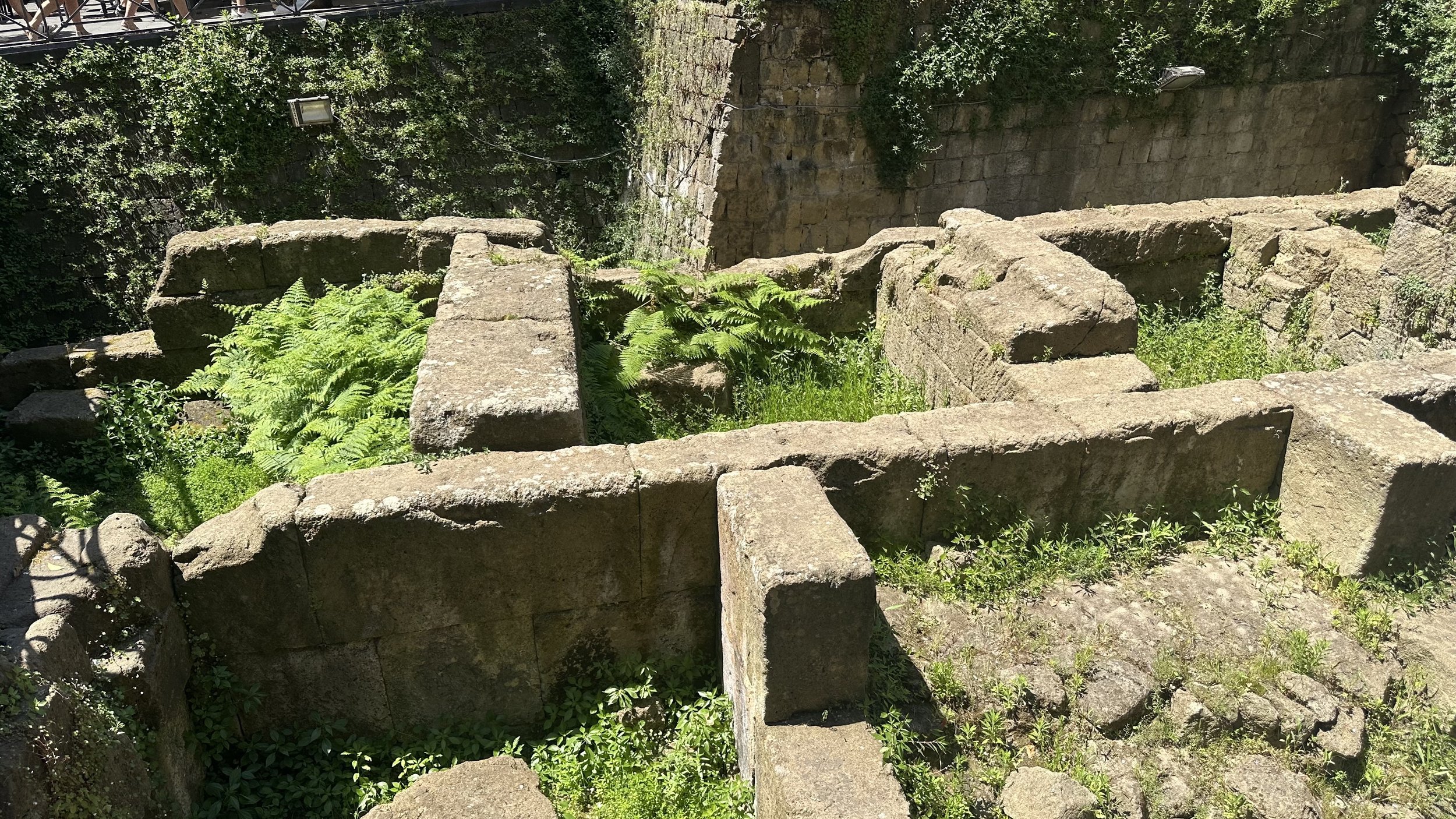
Rests of the ancient Greek walls still visible in Piazza Bellini.

During the Roman era, Napoli was called the city of ‘otia’ (literaly, the idle city) becoming a destination for holidays and an escape from the chaos of life in Rome.  Here the Romans started to be build aqueducts, public baths, theatres and villas. Many important historical persons decided to have houses in the city like the emperors Claudius and Tiberus and the poet Virgil, who is buried here.

With the decline of the Roman Empire, Napoli was invaded firstly by the Goths, then the Byzantine Empire and then by the Normans. 

As I already mentioned, Napoli was very desirable to many of the European empires and soon became an important strategic post in the Mediterranean, linking the western world to the east. It is with the German royal family of the Hohenstaufens that Napoli became a part of the Kingdom of Sicily under king Frederik II.  This was a very prolific period for the city, intellectually and artistically, it was the new centre of the Kingdom (even though Palermo was the actual capital). In Napoli, was founded one of the first Universitys in Europe, Federico II University, which still today ranks in the top ten of the most important universities in Italy. 

Meanwhile, the Angevin family started to conquer southern Italy, the Angevin duke Charles occupied Napoli, becoming the King of Sicily and moving the capital from Palermo to Napoli, residing in the Castel Nuovo (New Castel but also known as Maschio Angioino).  The new king promoted many architectural and artistic works in the city, building many churches, including the construction of the Cathedral.  More info in the section CHURCHES.

In 1282, after many wars, the Kingdom was divided in two. The Kingdom of Napoli was given to the Angevins and the Kingdom of Sicily to the Aragonese.  In 1302, Frederik III was king of Sicily and Charles II of Napoli, who called to his court many artists and intellectuals from all over Italy, like Giotto and Boccaccio.  However, the two separate Kingdoms didn't last very long as the rival Aragon king Alphonse I invaded Napoli in 1442. The Pala Strozzi pictured the battle between the Aragons and Angevins.
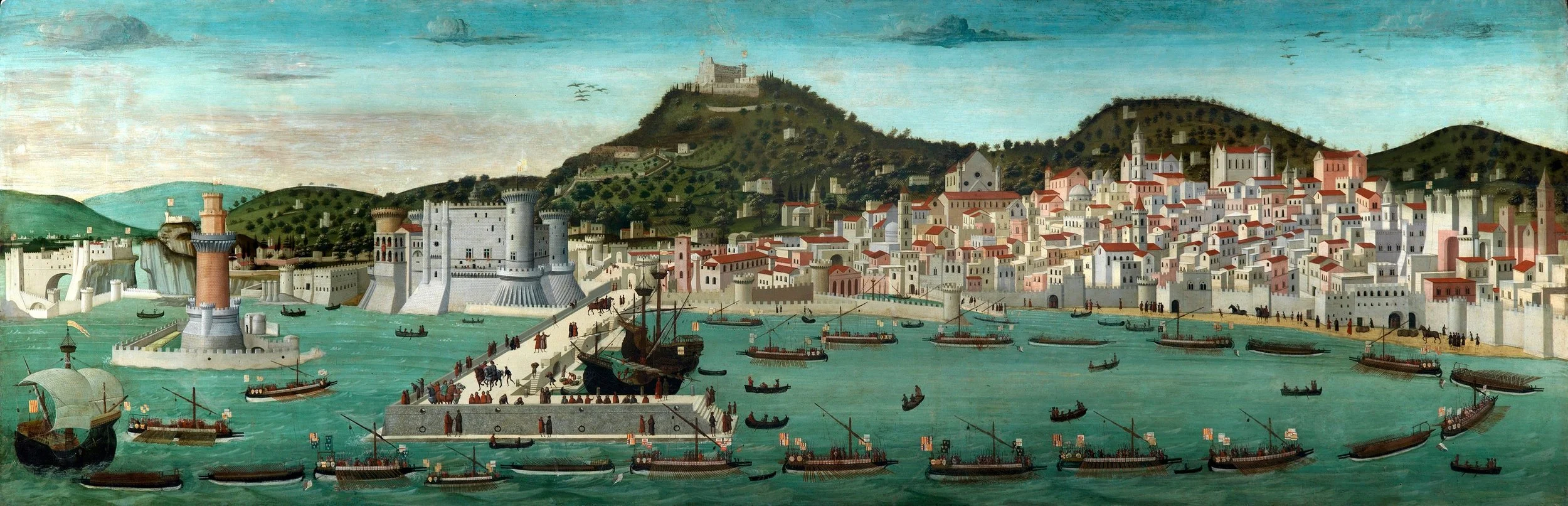
Tavola Strozzi, egg tempera on canvas, by Francesco Rosselli (attr.) 1472 - 73. (San Martino Museum).

In 1458, after the victory of the Aragon family, Ferdinand I was crowned King of Napoli. From that moment on, the city became the centre of the Renaissance in southern Italy. In 1503, king Ferdinand II the Catholic, included Napoli as part of the Spanish Kingdom, that lasted for another two centuries.  During the Spanish reign, Napoli came into the peak of its splendour, it was a powerful economical centre, an important port and an exciting artistic and intellectual place to be. The Spanish viceroy Don Pedro de Toledo made important social, economic, architectural and political reforms. He also made significant changes to the planning of the city, dividing it into quarters, building new forts and creating new streets, like via Toledo. 

By the 17th century, Napoli was the third largest city in Europe, after Paris and London. Even though, it was slowly declining because of the plague and the increase of poverty, it still was very important during the Baroque era, with the presence of Caravaggio, Bernini and the philosopher Giordano Bruno. 

The XVIII century was dominated by the presence of the Austrian king Charles VI, which lasted until 1738 thanks to the victory of the Spanish branch of the Bourbons with Ferdinand IV and then with Charles VII who gave some of the splendour back to the city with many new constructions. In Napoli was established the first railway in Italy.  In 1779, king Ferdinand IV divided the city into 12 quarters.

Today there are 30 quarters of the Comune di Napoli.
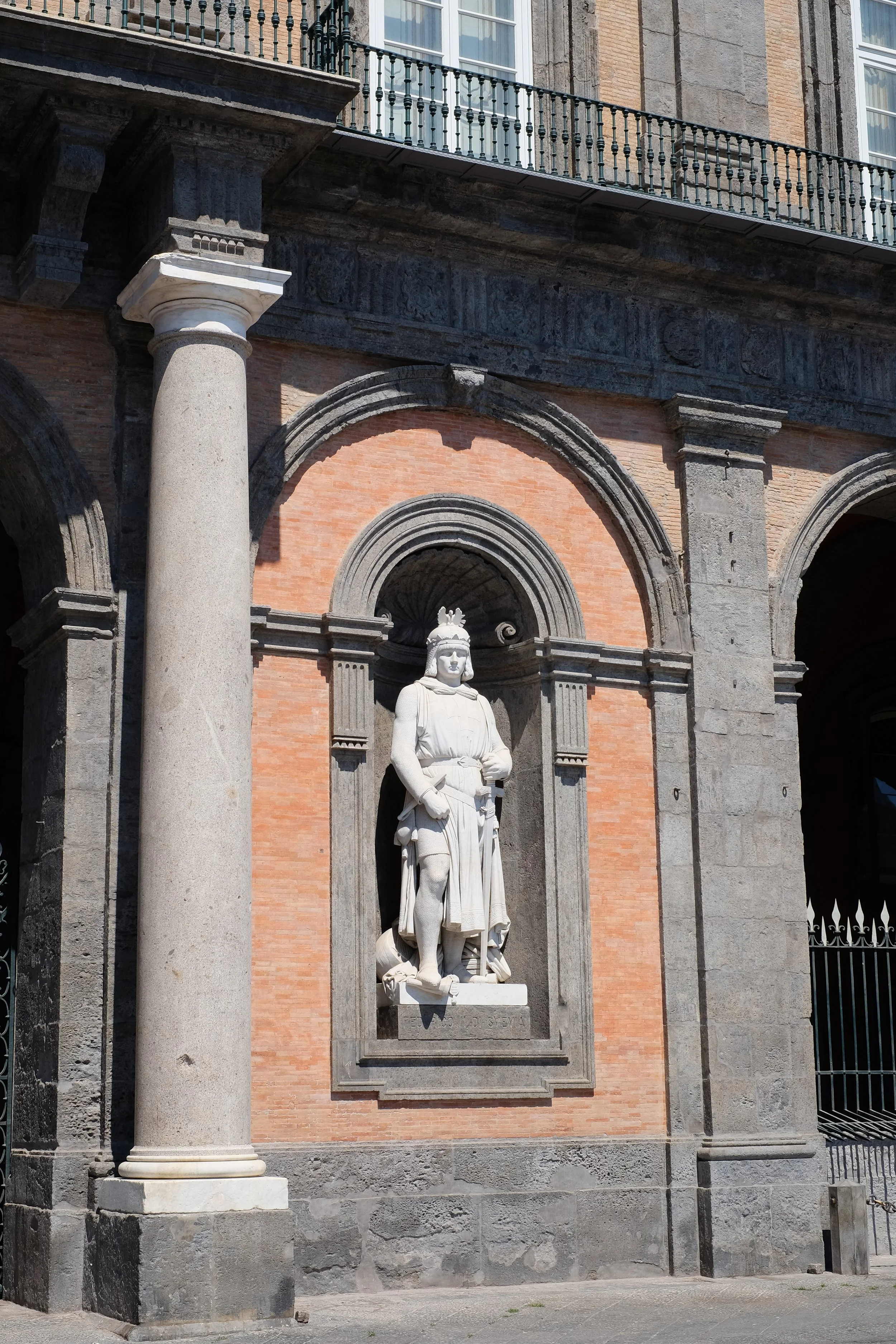
King Frederik II.
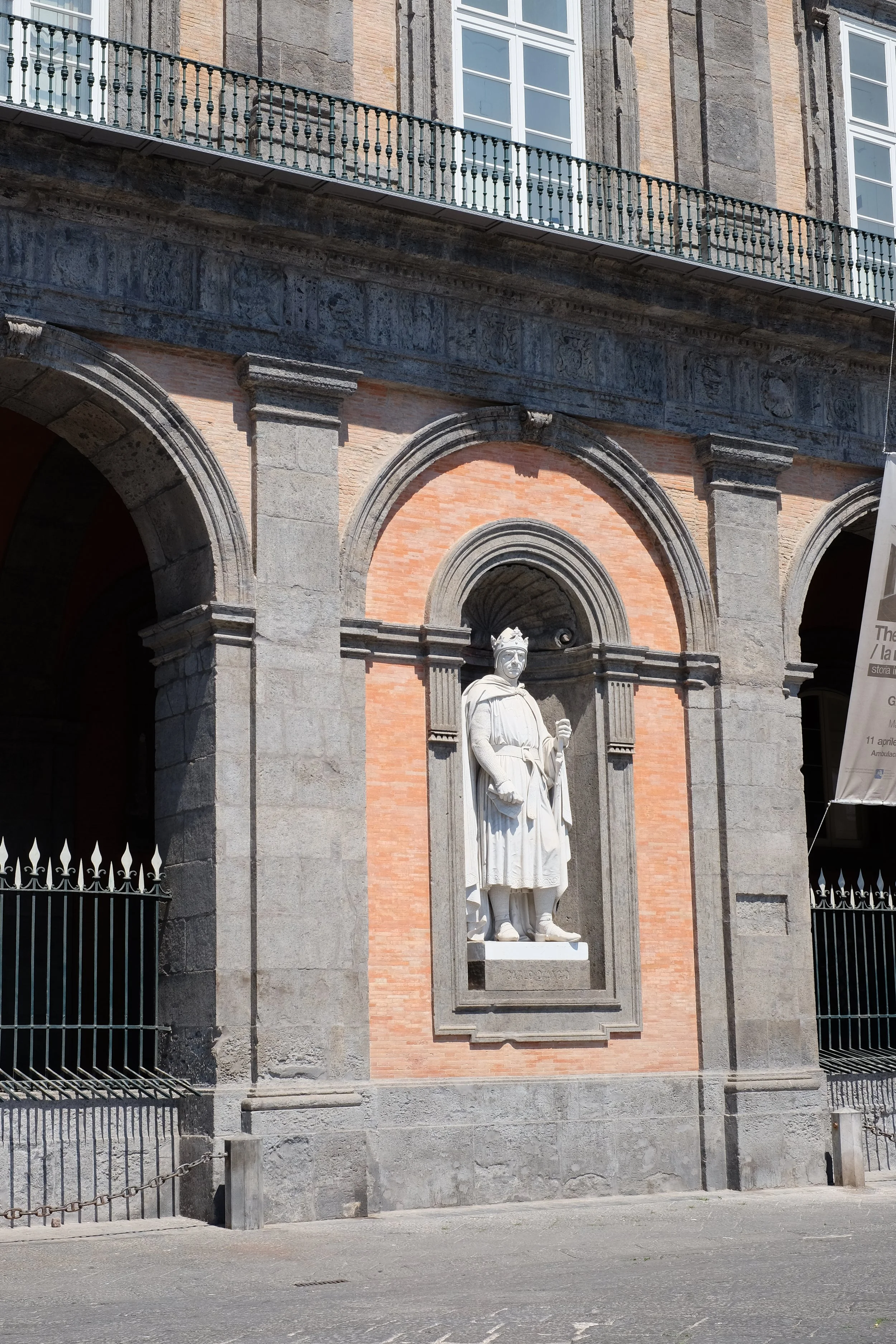
King Charles I.
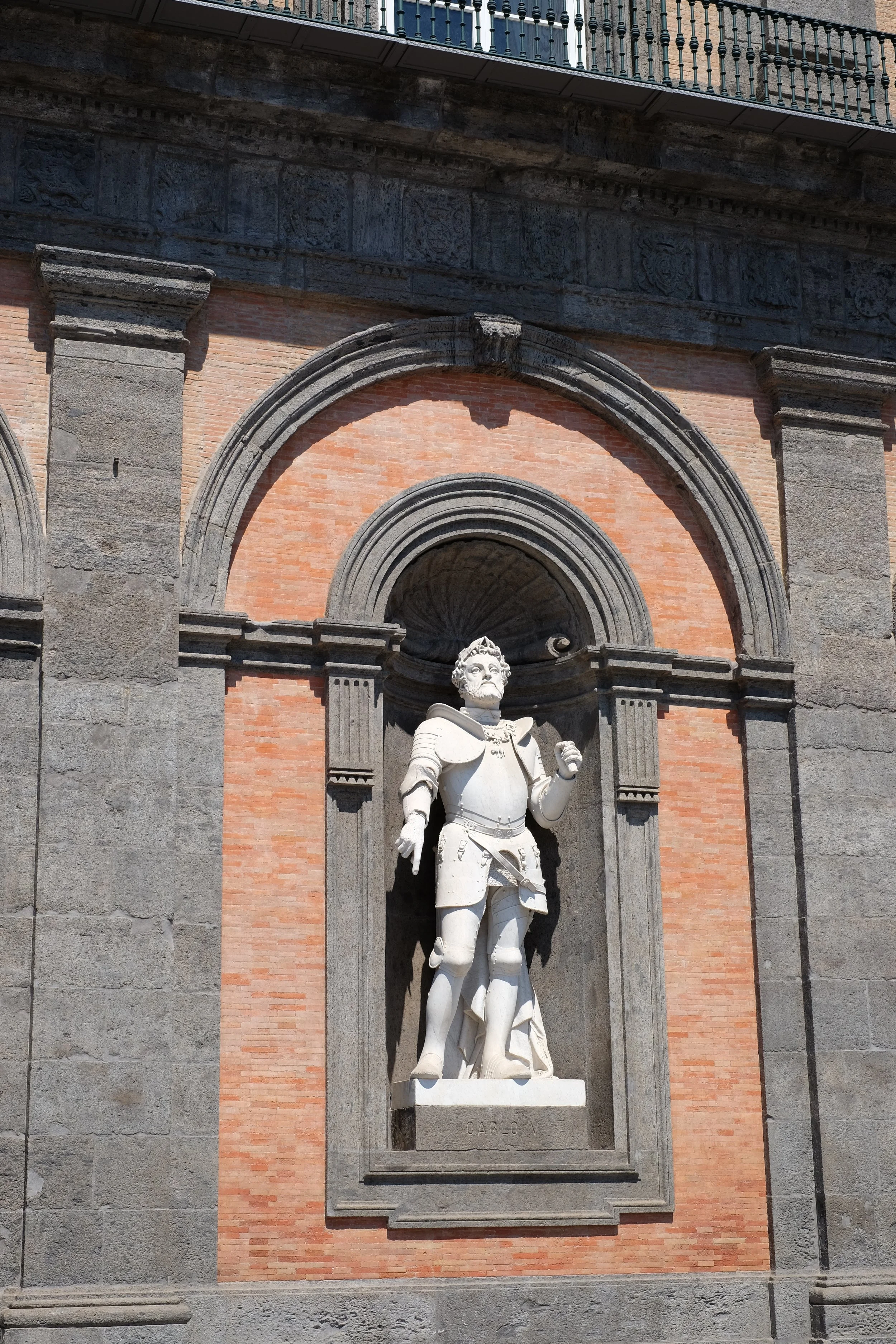
King Charles V of Asburg.
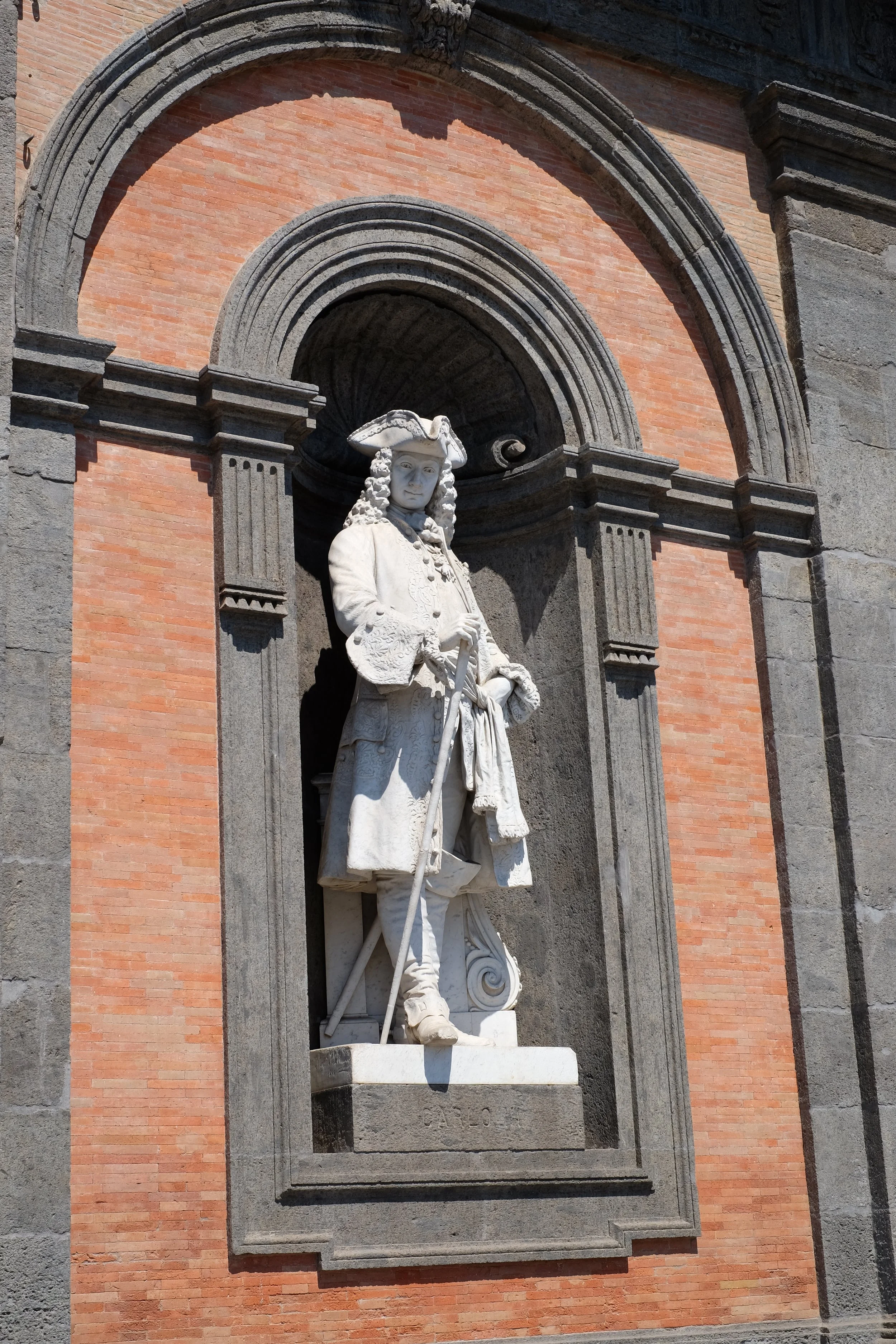
King Charles III.
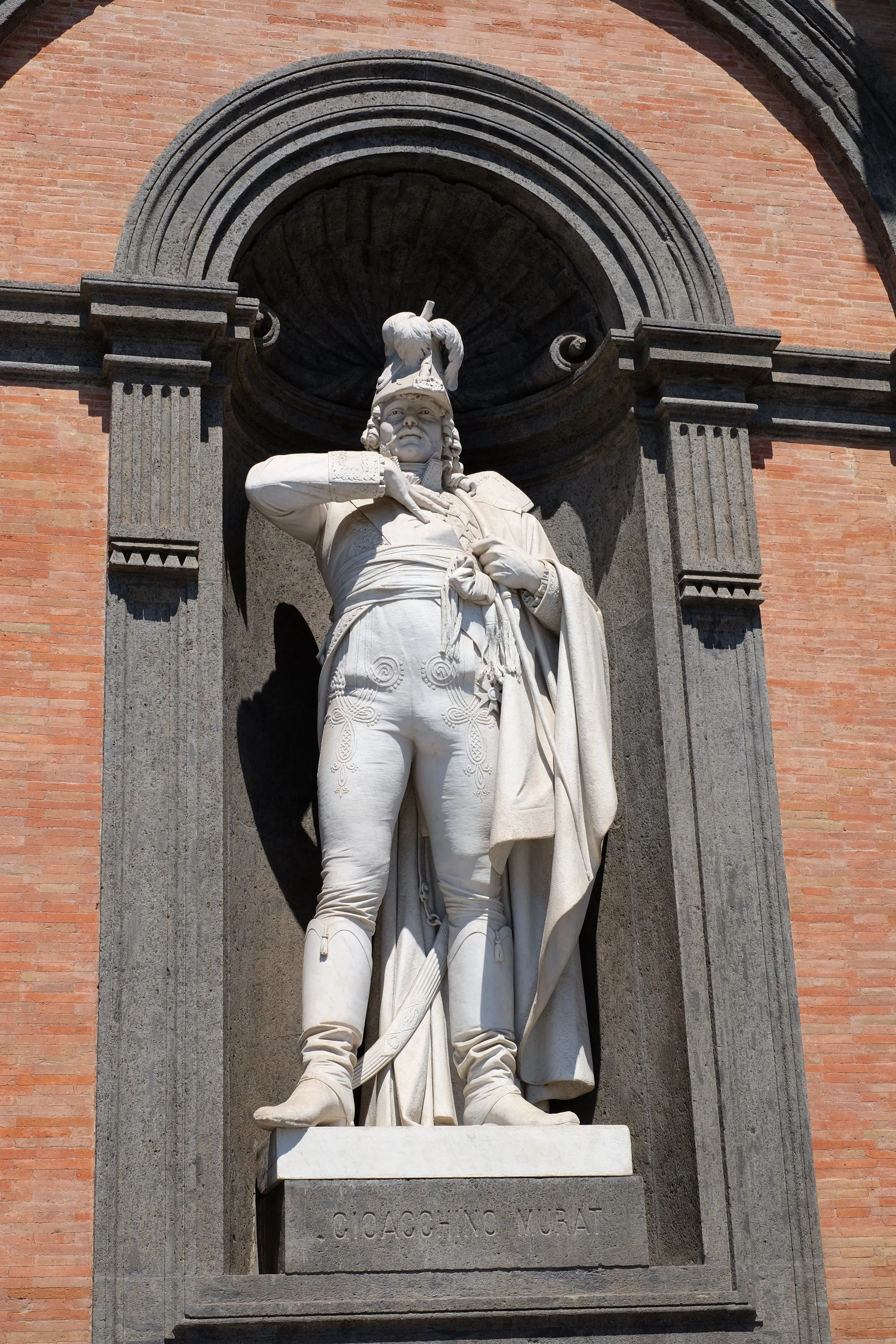
Gioacchino Murat.

Napoli was an important place during the French Revolution. The Republicans took Castel Sant'Elmo which became their fort and Napoleon conquered the city and gave it to his brother Joseph Bonaparte.  In 1815, Napoli was declared the capital of the Kingdom of Two Sicilies.

The foreign monarchies were expelled from Italy when Giuseppe Garibaldi started his 'revolution' to unify the country in 1861. 

During WWII, Napoli was the most bombed city in Italy. Many archives and churches, (see Santa Chiara church), were destroyed by the allied bombing. Towards the end of the Fascist era, the Neapolitans rose up against the German soldiers, holding out until the Americans and British armies freed the city in 1943.

UNESCO awarded the centro storico (the historic centre) of Napoli a world heritage site in 1995.

Napoli is one of the biggest cities in Italy with a population of almost 1 million inhabitants, including me, living under the majestic presence of Mount Vesuvius, facing the beautiful gulf and surrounded by the Sorrento coast to the east. The city has many hills, like the Vomero and Camaldoli. 

Napoli is considered the 'citta' del sole' (the city of the sun) for a good reason: here the sun shines for 250 days during the year!

The Neapolitan climate is Mediterranean, so very hot and dry in Summer (July and August in particular), mild with rains during the other seasons. 

When it best to go to Napoli?  

In my opinion, the best months are from April to June, the spring in Naples is stunning, mild but not too hot; however, September - October can be good months as well.  I would try to avoid the high season which is July and particularly August, when there is the big bank holiday of Ferragosto (15th) and the city is quieter, while the Sorrento and Amalfi coast is over crowed.  In winter, I really recommend to visit Napoli in December when all the city lights up for the festive holiday.  It is a great experience. 

When you come to visit Napoli you can feel all these centuries of history flowing through the streets of the city, into the food we eat (many Neapolitan traditional recipes are simply a reinterpretation of Spanish and French meals), and also in our personalities. As you can see, in our blood flows a mixture of many peoples: we are philosophers like the Greeks, practical like the Spanish, and elegant like the French.

Neapolitans can charm those who come to the city exactly like Parthenope. See Naples and die!
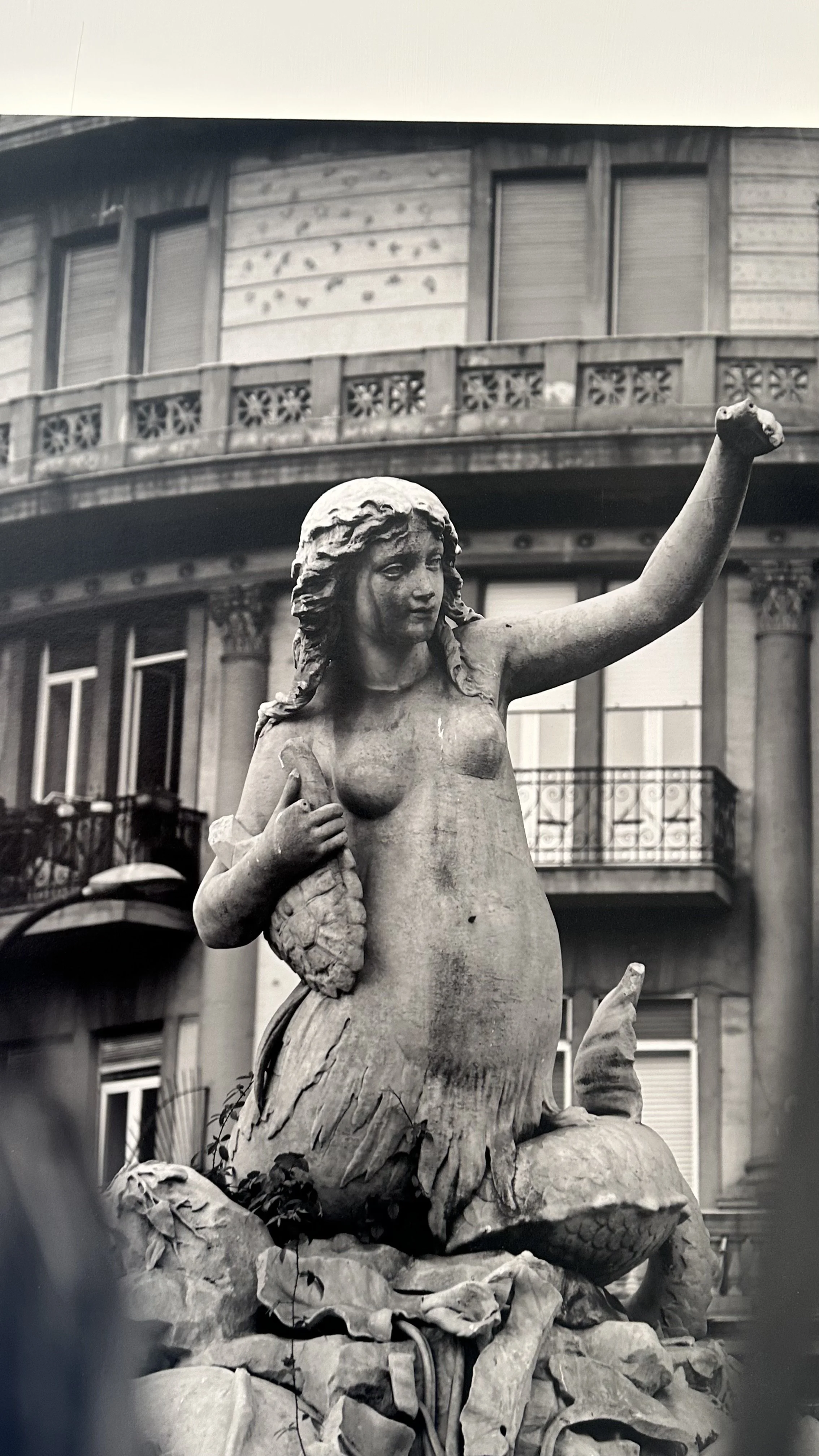
The Parthenope Fountain in Mergellina, constructed in 1869.

I wrote another blog about the exciting revival and rejuvenation of 21st century Napoli and how is leaving its difficult times behind and building for a more confident and brighter future. you can read it here: Napoli - THE RENAISSANCE.

Source: origins-of-napoli
In Archeology, History, Museums, Neapolitan Life, Tradition, Neapolitan kings, parthenope Tags Napoli, naples, secret napoli, secrets of napoli, HISTORY, myth, parthenope, mermaid, cit, inn, Italy, Italia, italian, visit, city, origin, vesuvius, vesuvio, greek, ulysses, odyssey, revolution, king, mediterranean sea, mediterranean, magna grecia, roman, roma, baths, theatre, campania, cathedral, cathedral of napoli, catacombs, archeological museum, kingdom, kingdom of sicily, kingdom of napoli, university, pala strozzi, spanish kingdom, french kingdom, french revolution, neapolitan kings, neapolitan history
Comment
What's hiding under Napoli?

What's hiding under Napoli?

The Underground City

October 9, 2023

Napoli is definitely a city with many wonders and thousands of secrets.  Every century left an important mark on the city making it how we see it today.  Napoli is not just a unique city on its surface, but also in its depths.  Napoli was founded by the Greeks around 500BC. and by physically going down under the streets of Napoli you can discover remnants of the original Greek city. This area is called decumani (decumans), from the old term indicating the main streets that ran through the city (today via Tribunali, via Constantinopoli and via Benedetto Croce).  You can still visit the Greek tunnels underground where the population used to hide during the bombing of WWII. 

There are different sites where you can book your excursion under the city offering different tours (available in other languages as well). 

One of the most famous is the Napoli Sotterranea, near via dei Tribunali, one of the busiest streets of the old part.  The guide will take you down to the very depths under the centro storico (old town). 

The entrance of Napoli Sotterranea in via dei Tribunali.

The entrance of Napoli Sotterranea in via dei Tribunali.

The visit starts from the 136 steps that go down the ground for about 40 metres. Warning: it is always desirable to bring a jumper as the temperature drops dramatically (or can also be a nice refreshment from the heat).

The steps down.

There are 136 steps down to the tunnels. They are 40 metres below ground. Warning: it is always advisable to bring a jumper as the temperature drops dramatically (or otherwise it can also be a nice refreshment from the heat). One of the best parts to see is the Greek-Roman Aqueduct, big cisterns of water which used to supply the city, and the the remains of the Roman theatre, accessible through a typical Neapolitan house.  During WWII, these tunnels were used by the Neapolitans as shelter from the aerial bombing that was destroying and damaging the city.  Many objects of daily life were found, like children's toys, clothes and books.  There is even a Hypogeum Garden,  a scientific project dedicated to the power of the Earth. The garden, is in fact a great attraction not only for tourists but also for scientists and botanists.  Here there is a variety of vegetable plants, which were able to grow despite the absence of natural light.

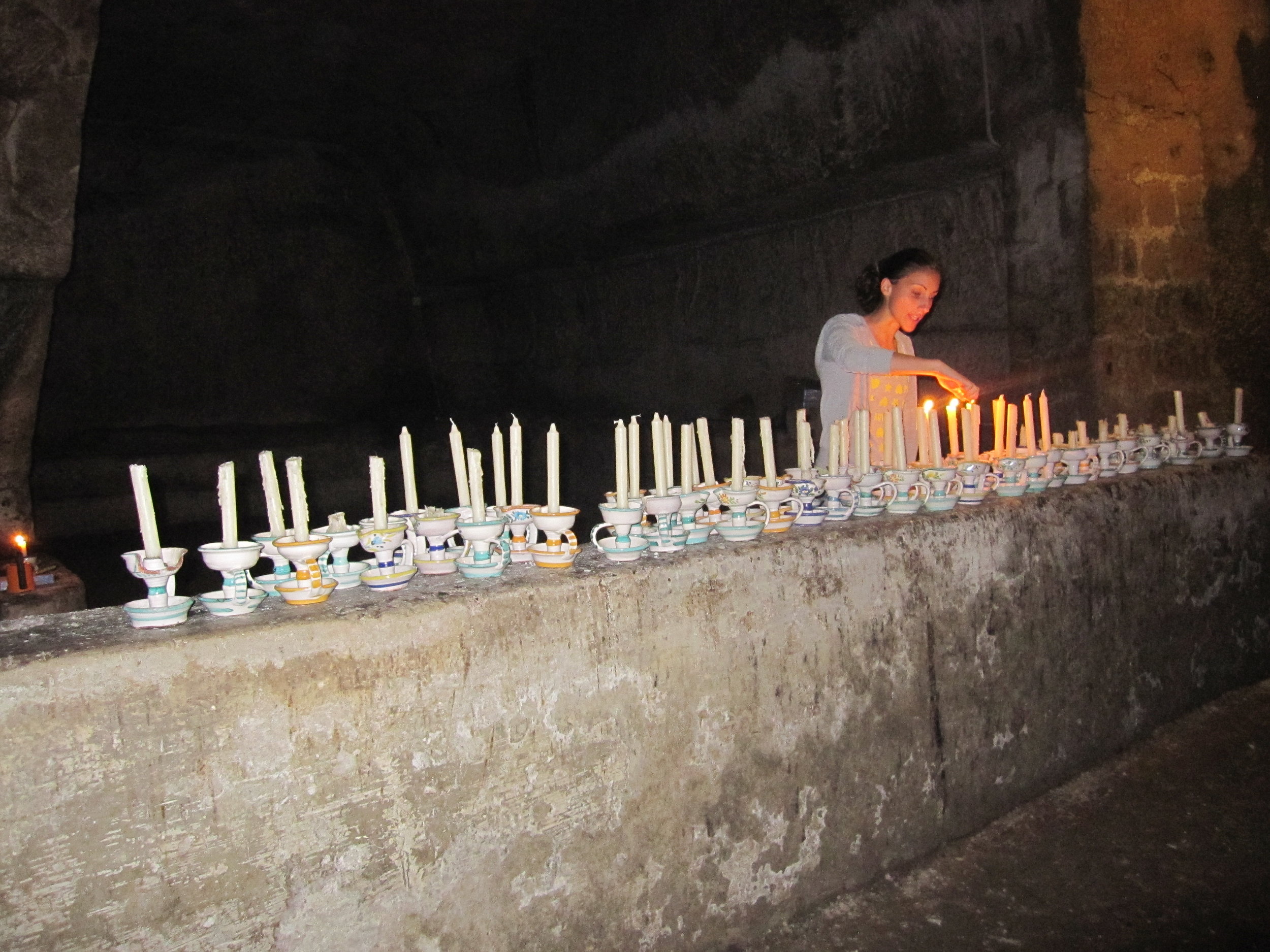
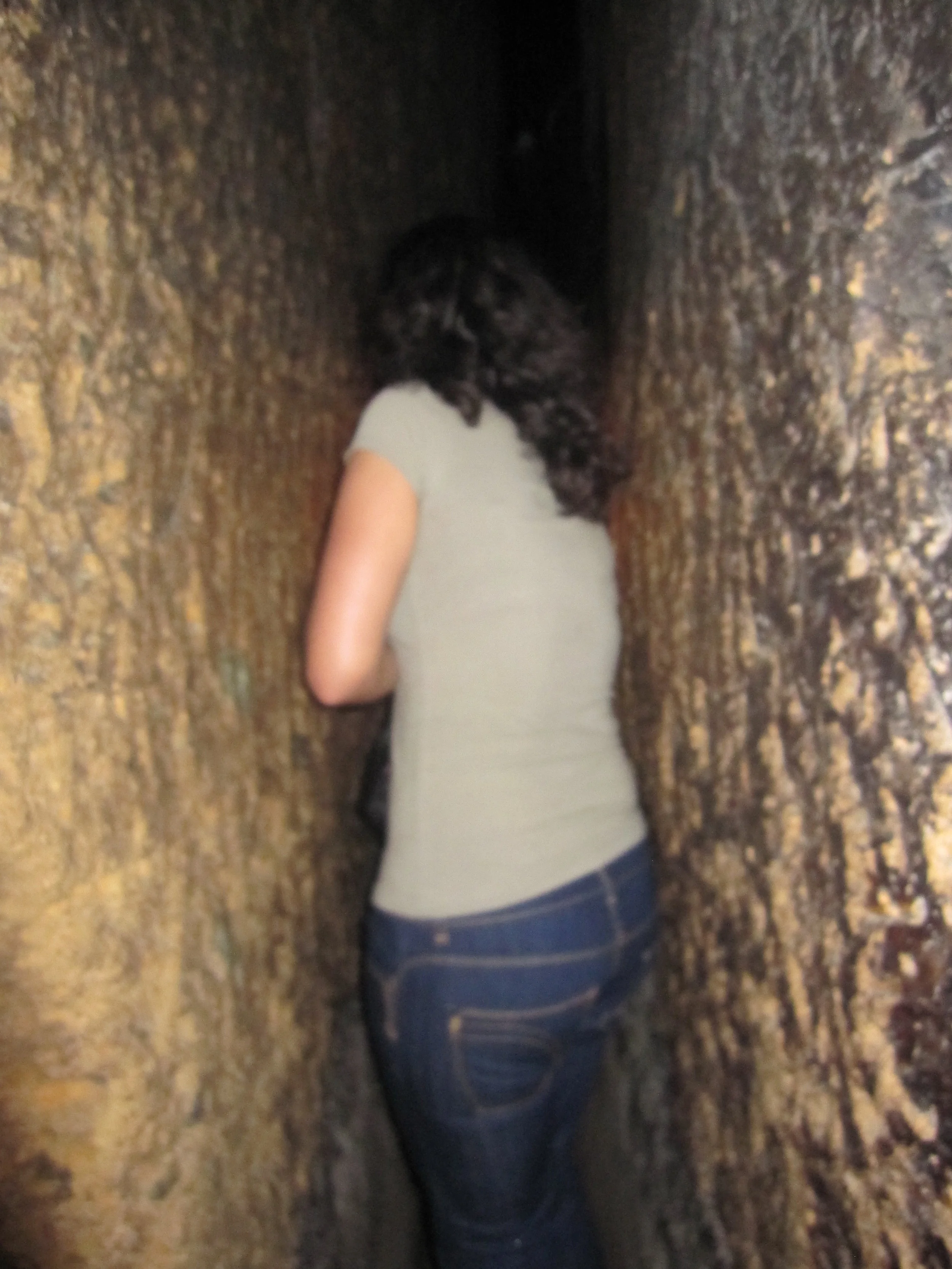
Overall, this tour is very interesting and I really suggest to do it if you have the time. Although, i must warn you if you are claustrophobic!  During the visit you will be able to walk through very narrow tunnels carrying only a candle!  In case you don't feel comfortable to continue, the guide can take you back to a certain level where you can wait for the rest of the group to come back.  To know more about this excursion, visit the official website of Napoli Sotterranea or go to the bottom of the post for tickets and timetables.

The Pozzari were men who used to carry vases to supply the city with water.

The Pozzari were men who used to carry vases to supply the city with water.

Cisterns of water.

Cisterns of water.

The Hypogeum Garden.

The Hypogeum Garden.

The only way to get around the tunnels.

The only way to get around the tunnels.

Some of the caves were used as shelter from the bombing during the WWII.

Some of the caves were used as shelter from the bombing during WWII.

The narrow underground tunnels.

The narrow underground tunnels.

Not far from the Napoli Sotterranea in piazza San Gaetano, there is the San Lorenzo Maggiore church, here you can have a guided tour of the archeological site under the structure of the church. The excursion starts at almost 10 metres under the city from the medieval remains of the church, continuing to the remains of the Greek and Roman city where there are still the visible ruins of the market, a temple, shops, houses, marvellous mosaics and marble architectural remains.  Archeologists have outlined a map of the ancient city where the church now is.  More info about the excursions on San Lorenzo Maggiore or visit the official website or go to the bottom of the post. 

Greek and Roman streets of the ancient city under the church of San Lorenzo Maggiore.

Greek and Roman streets of the ancient city under the church of San Lorenzo Maggiore.

Shops of the ancient underground city.

Shops of the ancient underground city.

Temples and private habitations under the church of San Lorenzo Maggiore.

Temples and private habitations under the church of San Lorenzo Maggiore.

Another interesting tour under Napoli is the Bourbon Tunnel.  In 2007, a group of geologists discovered a tunnel long about 84 meters of carafa caves just under Piazza Plebiscito.  The construction of the tunnel started in 1853 and finished in 1855 for king Ferdinand II of Bourbon.  The underground tunnel linked the Royal Palace to the sea, its purpose was as a secret tunnel to move the royal troops. The tunnel was divided in two sections, the Royal Gallery and the Road Regia, one for carriages and the other one for all the pedestrians.

In the years of WWII, the Bourbon tunnel was also used as an air raid shelter.  The geologists found a large amount of personal items and objects, cars, motorbikes and vehicles, even statues and funeral monuments.

There is also a tour around the Catacombs of Napoli where you will find the the final resting place of thousands of Neapolitan skeletons from centuries past .  There are different tours, one of the most popular is to visit the San Gennaro catacombs.  San Gennaro is the saint protector of the city, and here is where his remains where originally found.  Today his remains are in the Cathedral (Duomo). The area of the catacombs is quite spacious and it is divided in two levels: covered in tuff (tufo, typical Neapolitan stone that covers most of the underground tunnels) there is the lower catacombs, with a baptismal basin, and an upper level were the tomb of San Gennaro was.  Probably originally these spaces were used as a sepulchre of an aristocratic family and then used by the christian community around the 2nd century A.D.  Later additions were made in order to keep the remains of Sant Agrippino, the first patron of Napoli, in the 4th Century A.D.  Another interesting place to visit is the Bishops Crypt and the underground cathedral. Miglio Sacro is in the area of Sanitá, which links all the churches to the catacombs. 

All these different tours of underground Napoli are very interesting journeys through the history of the city.  I really suggest to try and do at least one of these tours, if you can, first because it's a unique experience ( in no other city it is possible to see, even in Rome) and also because it is a different way to understand what's below the surface and to discover the centuries of history buried under Napoli. 


Official website: Napoli Sotterranea
Piazza San Gaetano 68 Napoli
Tel.: 0039 081 296944 / 0039 081 0190933
Mobile: 0039 392 1733828 / 0039 334 3662841
Email: info@napolisotterranea.org

Timetable excursions: in English 10,00-12,00 / 14,00-16,00 / 18,00

Also tours in other languages (french, german, spanish). 

Duration of the tour: about 2 hours.

You can book online on the official website or on the official app.


Official website: San Lorenzo Maggiore - La Neapolis Sotterrata   

Piazza San Gaetano 316 Napoli

Tel.: 0039 081 211 0860 / Whatsapp 0039 389 1091 865

Email: visite.sanlorenzo@libero.it

Timetable tours:  9.30 - 17.30  (everyday) Timetable excursions: in English 11,00 / 13,15 / 15,15 / 17,00

Tickets: € 9 /  € 7 with Artecard, for teachers, university students and Over 65 /  € 6 Under 18 / € 4 School groups / Free under 6.


Official website: Bourbon Tunnel - il Tunnel Borbonico. 

Tel.: 0039 366 248 4151 / 0039 081 764 5808

 Email: mail@galleriaborbonica.com

The tour to the tunnel has three different entrances and for each entrance there is a different tour with different fees.  Some tours are not suitable for children. 

Official website: Catacombs of Napoli - Catacombe di Napoli. 

Via Capodimonte, 13  (Entrance near the Basilica del Buon Consiglio).

Tel.: 0039 081 744 37 14
Email: info@catacombedinapoli.it


Source: 2018/4/24/the-underground-city
In Naples Churches, Museums, Neapolitan Life, Archeology, Catacombs Tags Napoli, Naples, undeground, city, inner city, history, archeology, ancient Rome, ancient greece, ancient greek, underground city, secret napoli, secrets of napoli, Italia, Italy, italian, tour, tourists, tourism, touristic, tour guide, tunnel, street, streets, catacombs, tombs, roman aqueduct, aqueduct, roman theatre, theatre, wwII, HISTORY, church, temple, map, bourbon tunnel, san gennaro, crypt
Comment

Welcome to Napoli ….. City of Art and…..Champions of Italy!

Napoli - THE RENAISSANCE

June 21, 2023

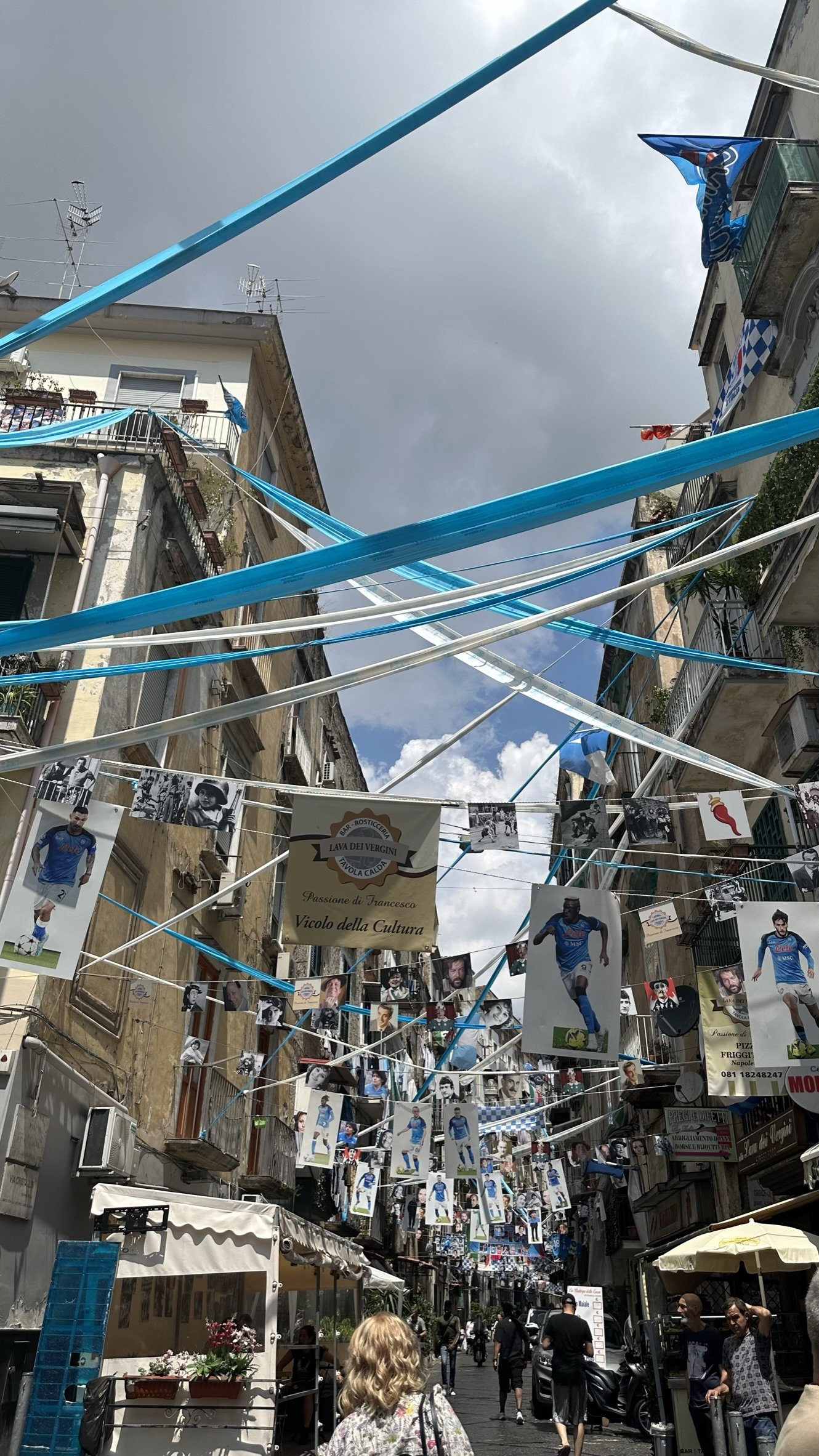
If you have been in Napoli these past months, you must have seen an explosion of blue & white banners, flags and pictures of Maradona around the city. Probably you must have thought ‘what’s going on here?’. It’s a very simple explanation. Napoli football club won the serie A, which is the the main football championship in Italy.

It is very hard for me to explain what this victory means for the city.

Because is NOT just a game, but it is much much more. A lot more.

Napoli is feeling like it’s a city on the up. The successful football season gave the city a new vibrant, self confident feeling. Yes, because you might think ‘It’s just a game’. Probably true, but not in Napoli. We live everything to the extreme! Including football.

We need to go back a few years to fully understand why football is so important to the citizens of Naples.

Precisely 33 years ago there was a man called Maradona. You can love him or hate him, surely as a human being he can be criticised, but as a football player (except for the English) he was a God, at least in Napoli.

I am old enough to remember what he did for the city. When he arrived in 1984 the city was in a sorry state of decline and the football team were a real disaster. But he gave Neapolitans hope. It was like David against Goliath, the hopeless Neapolitan team of the south against the big boy rich teams of the north, such as Juventus, Inter & AC Milan. No one believed in us, but Maradona took Naples to two league championships and to UEFA cup glory.

Maradona was the catalyst that initiated Naples steady ascent from the dark days of urban decay and crime to a reawakening of what Naples had to offer the world. Beauty, passion, life and vitality. Since the pandemic this renaissance has accelerated. Improvements in infrastructure and ambitious civic projects are finally unlocking the potential of the city. Today it is a safer more business friendly city. Tourism as well is growing rapidly. Once, not so long ago, tourists would only fly into Naples to use it only as a gateway to Sorrento and the Amalfi coast. But now all that is changing. People from all over the world are finally discovering what an incredible city Napoli is and it is becoming a destination city like Rome, Florence or Venice.

Going back to the football, that is why it is so important. Because it has given the city a new optimistic and joyful vibe. Even the elderly ladies at the market were talking about it like they were professional managers! Around March this year, despite the famous superstitious nature of the Neapolitan people, we started to decorate the streets with blue and white flags even before it was certain that Napoli would win the championship!. It didn't really matter, Neapolitans were happy to be doing so well anyway. We were determined to enjoy the moment we had been waiting 33 years for.

Believe me, in all my life I’ve never seen my city so beautiful and joyful, and studying art I feel proud that tourists are discovering and loving Napoli with its amazing architecture, its incredible treasures, its beautiful landmarks and traditions, and of course food.

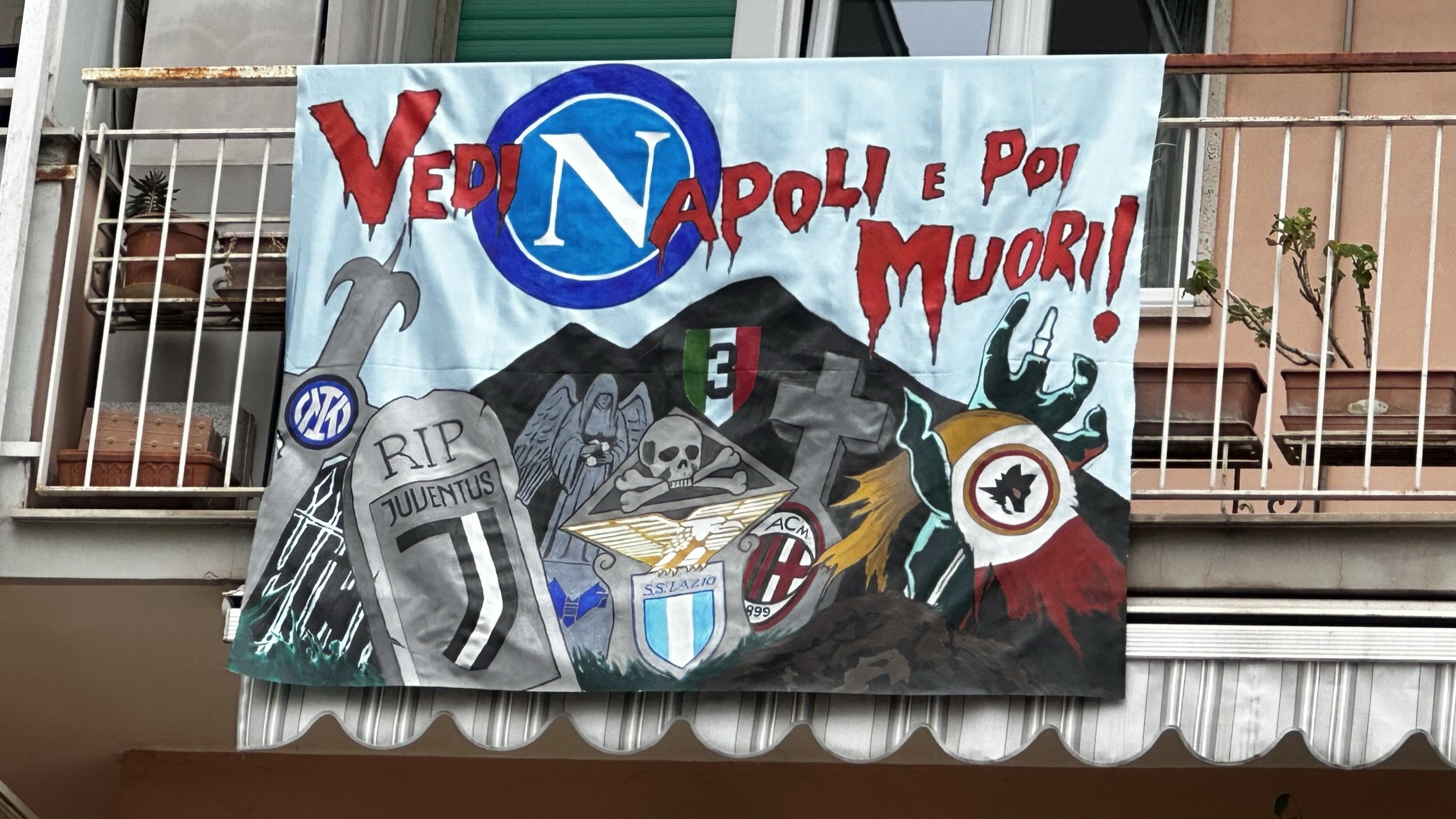
It is safe to quote Goethe ‘See Napoli and then die’ (‘Vedi Napoli e poi muori’) because there’s no other place like it.

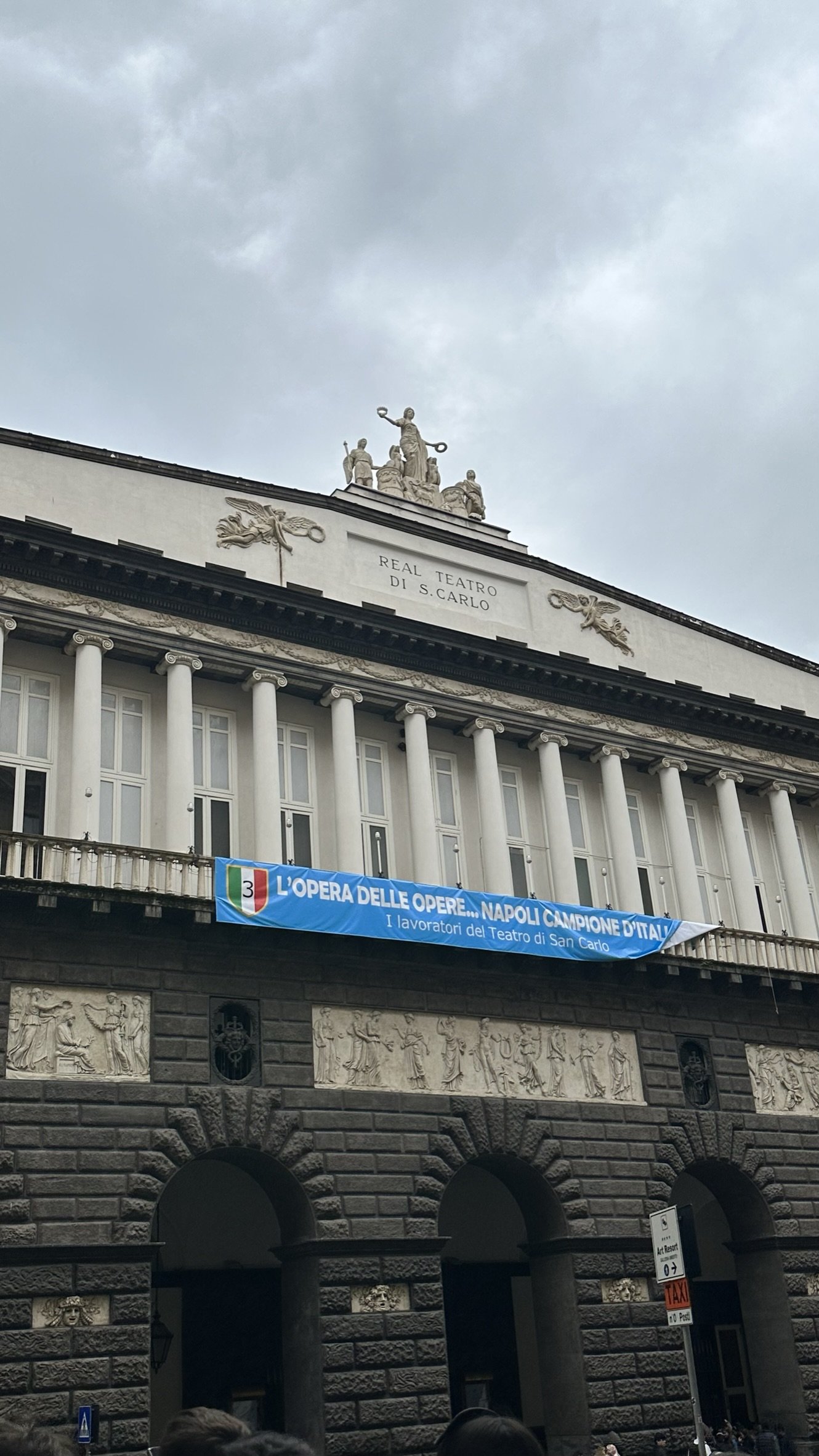
From the Opera House San Carlo ……

to Piazza Dante….

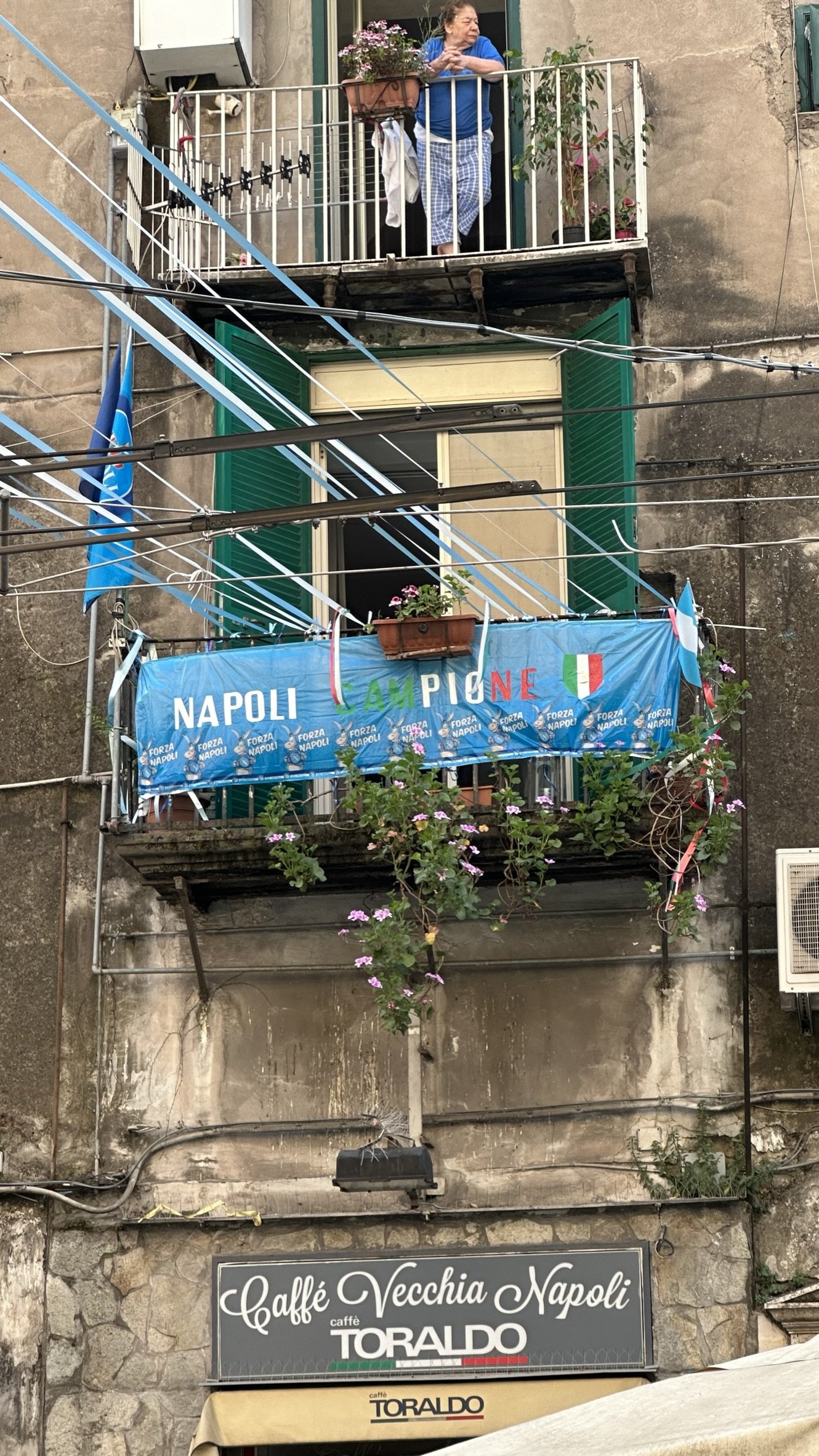
Banners and flags all over the monuments and buildings.

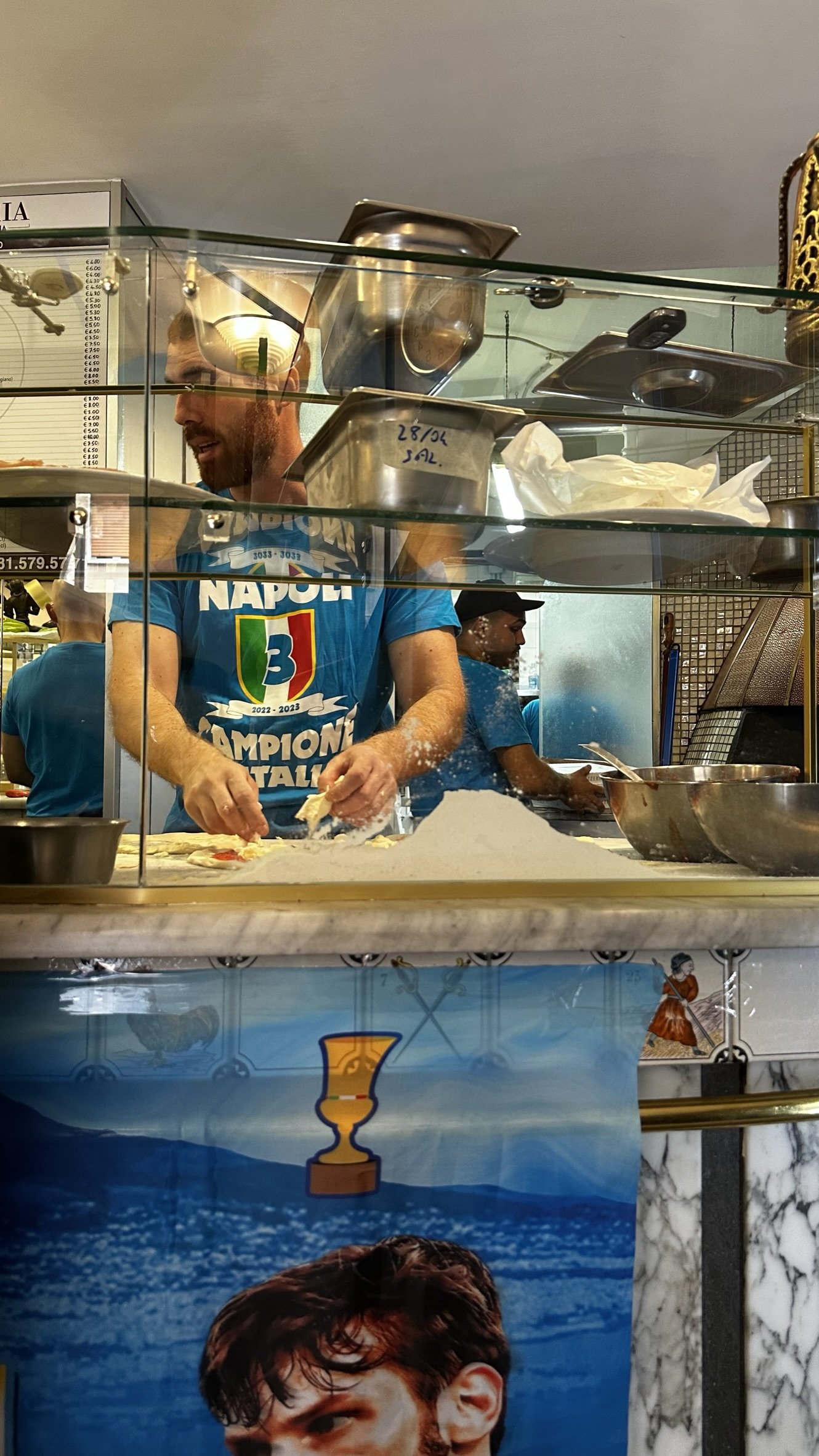
From the pizza…..

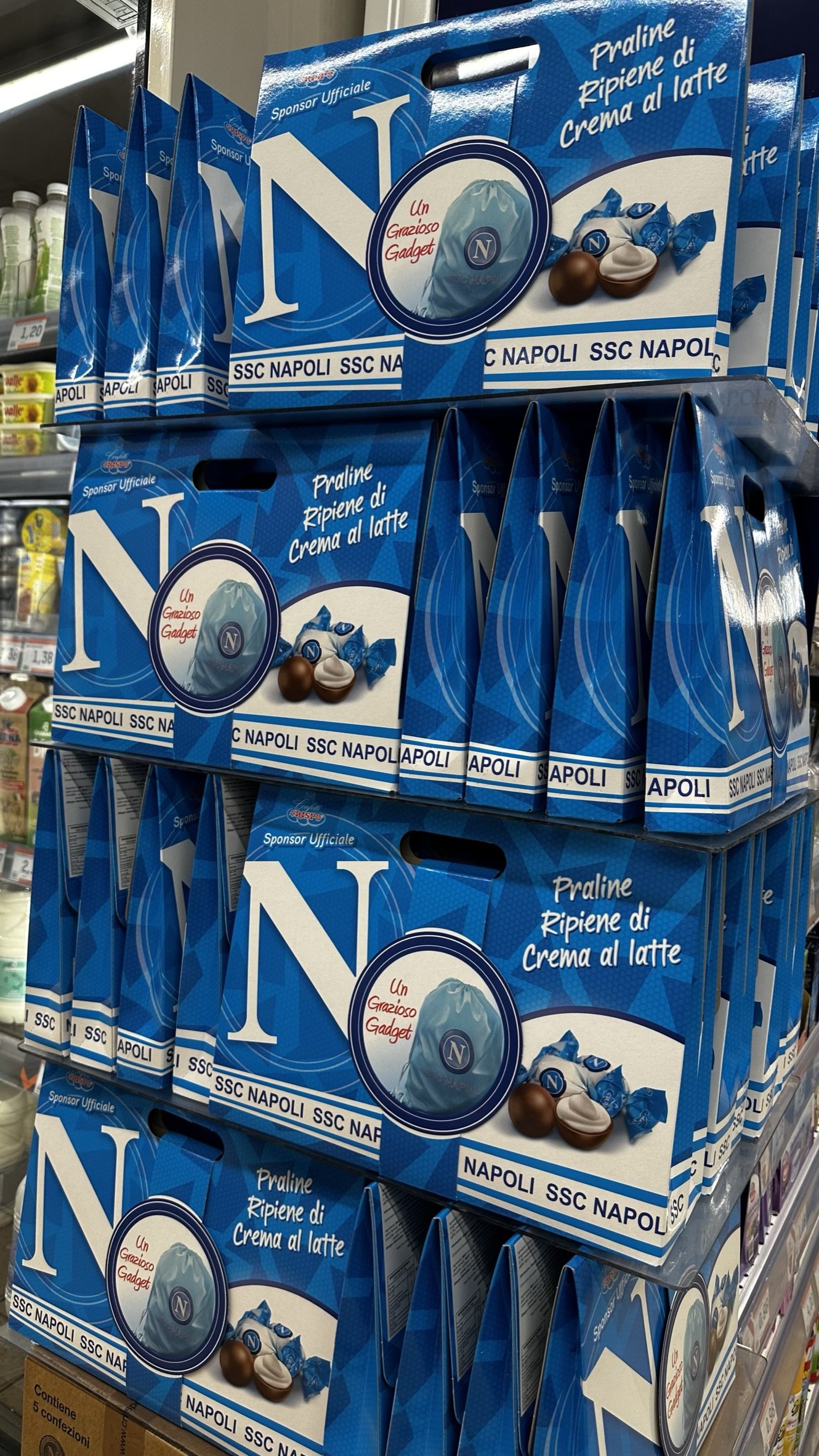
to chocolates…..

to pasta. Everything is merchandising!

I asked my artist husband to make banner ……he made a masterpiece!

In loving memory to my dad (big Napoli fan), his favourite flag!

Old kings……

New kings…..

In Neapolitan Life, Summer, football club Tags Napoli, Naples, city, football, team, scudetto, renaissance, tourists, inner city, serie A, Maradona, visit, Italy, Italia, travel, travelling, holidays, summer, travelblogger, blogger, blog, italian, italian football, victory, win, old town, centro storico, tour, tour guide, tourism, touristic, vibe, wanderlust, traveler, traveling, football club, club
Comment

BLOGS.

Click on picture

Featured
IMG_6621.jpg
May 4, 2026
A new city between Myths and History. The origins of Napoli.
May 4, 2026
May 4, 2026
San Gennaro : the story and cult of the Neapolitan icon.
September 7, 2025
San Gennaro : the story and cult of the Neapolitan icon.
September 7, 2025
September 7, 2025
IMG_4132.jpeg
September 17, 2024
RIONE SANITA'
September 17, 2024
September 17, 2024
image-asset.jpeg
November 16, 2023
PRESEPE NAPOLETANO
November 16, 2023
November 16, 2023
DSCF9030post.jpg
October 9, 2023
The Underground City
October 9, 2023
October 9, 2023
IMG_4334.jpeg
June 21, 2023
Napoli - THE RENAISSANCE
June 21, 2023
June 21, 2023
tempImageYsxTe5.jpg
May 31, 2022
The Girl From Naples Is Back!
May 31, 2022
May 31, 2022
IMG_0149.JPG
June 4, 2018
Underground Napoli: The Metro.
June 4, 2018
June 4, 2018
May 5, 2017
Pizzeria da Michele: London vs Napoli.
May 5, 2017
May 5, 2017
March 27, 2017
Religion and Devotion in Napoli.
March 27, 2017
March 27, 2017